Building a new home in the DMV means the window package gets locked in before drywall goes up, and that decision drives energy bills, code inspections, and curb appeal for decades. Window installation for new construction is not the same job as a replacement retrofit, and picking the wrong approach costs builders and homeowners real money in change orders and failed inspections.
- Vinyl double-hung windows remain the safe default for window installation for new construction in 2026 budgets — buy.
- Fiberglass casement windows cost more upfront but outperform vinyl on U-factor and warping — consider for upgrades.
- Nailing-fin windows must go in before house wrap is taped; flange placement mistakes cause the most failed inspections in Woodbridge, VA builds.
- Skip standard aluminum-frame windows on any DMV new-construction project — condensation and code compliance issues are common.
- DMV Window Repairs handles new-construction window installation across Woodbridge, VA and the wider DC, Maryland, Virginia region.
Why this matters
A new-construction window goes into a rough opening that's still exposed to weather, framing tolerances, and inspection schedules. Get the flashing sequence or the U-factor wrong and you're either failing an energy code inspection or replacing units after drywall is already hung. DMV Window Repairs sees both outcomes regularly on jobs across Woodbridge, VA and the surrounding DMV area, and the fix is almost always decided at the ordering stage, not the install stage.
Most DMV jurisdictions enforce a U-factor of 0.30 or lower and a solar heat gain coefficient (SHGC) around 0.40 under current energy code adoption, and that single spec eliminates a chunk of the cheapest window lines on the market. Builders who ignore it in 2026 end up re-ordering mid-framing, which delays the whole schedule by two to four weeks in a typical single-family build.
Who this is for
This guide is for builders, general contractors, and homeowners managing a custom new-construction project in Woodbridge, VA or elsewhere in the DC, Maryland, Virginia region who need to spec windows before framing locks in the rough openings. If you're replacing windows in an existing house, this isn't your guide — retrofit windows use a different frame type and installation method entirely.
What to look for in window installation for new construction
Nailing fin vs. flange type
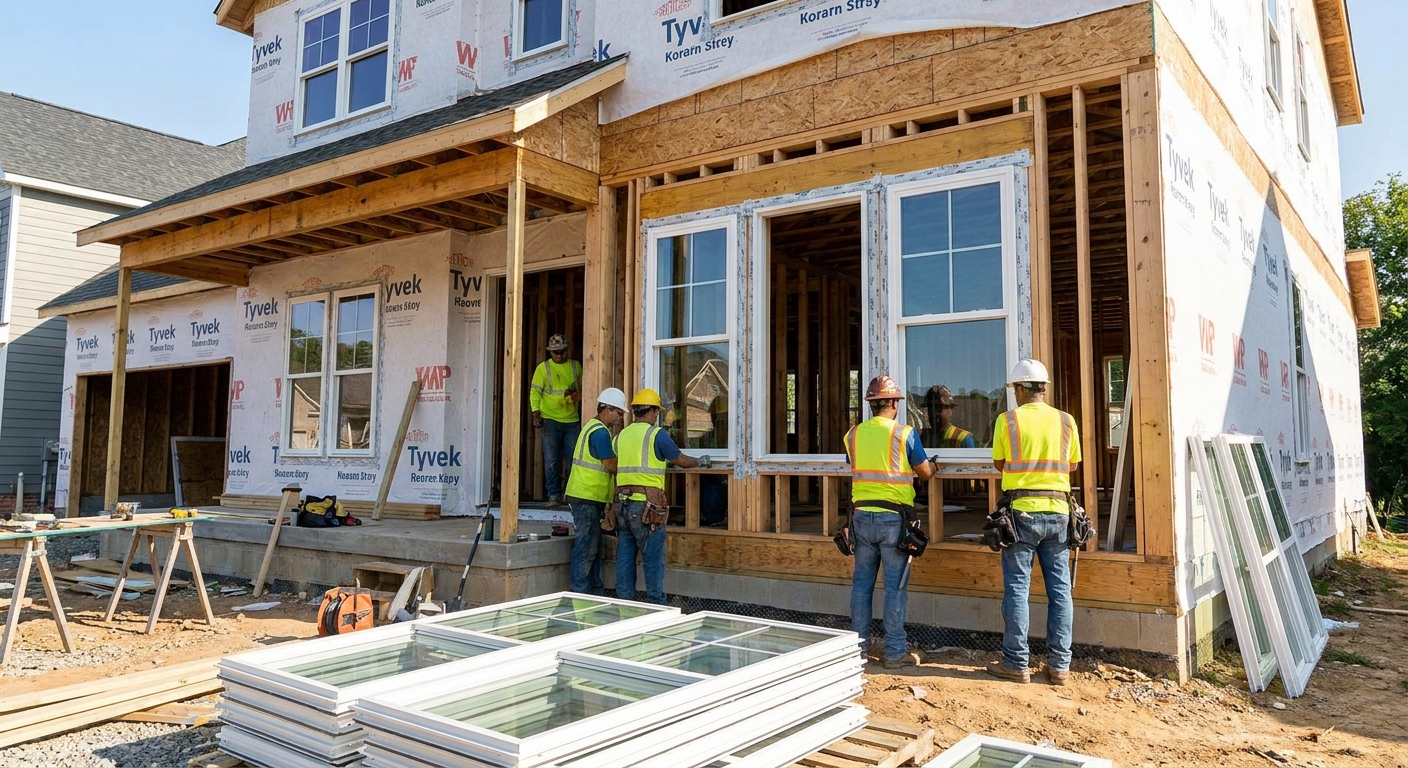
New-construction windows use a nailing fin (also called a flange) that gets fastened directly to the sheathing before house wrap goes on. This only works when the window ships before the weather barrier is installed — order too late and you're stuck retrofitting a new-construction unit like a replacement window, which voids most manufacturer flashing warranties.
Energy performance for the DMV climate
Virginia, Maryland, and DC sit in climate zone 4, where a U-factor at or below 0.30 and an SHGC near 0.40 are standard targets for 2026 code compliance. Windows rated above that threshold pass in some neighboring states but fail local energy inspections here, so check the NFRC label before you place a bulk order.
Rough opening tolerance
Framing crews typically leave a rough opening 1/2 inch larger than the window's nominal size on each side, but tolerances tighter than 1/4 inch cause binding on operable units within the first year. Confirm rough opening dimensions against the actual window schedule before framers close in walls — a mismatch here is the single most common callback reason on new builds.
Material and warping resistance
Vinyl, fiberglass, and wood-clad frames all perform differently under DMV's humidity swings between summer and winter. Fiberglass expands and contracts at roughly the same rate as glass, so it holds seal integrity longer than vinyl in the temperature range this region sees between January and August.
Warranty coverage on installed units
Manufacturer warranties on new-construction windows often exclude labor once a window is installed by a third party, and some void coverage entirely if flashing isn't done to spec. Confirm whether the warranty follows the window or the installer before signing off on a bulk order for a multi-unit build.
Installation sequencing with the building schedule
Windows need to arrive on-site within a tight window between framing completion and house wrap installation — order too early and units sit exposed to jobsite damage, order too late and the schedule stalls. Coordinate delivery dates against the framing inspection date, not the closing date, to avoid holding up the whole crew.
Top picks for new-construction window installation
Vinyl double-hung — the safe pick. U-factor typically lands between 0.27 and 0.32 depending on the glass package, and it's the most common spec on single-family builds across the DMV in 2026. Verdict: Buy for standard residential builds on a fixed budget.
Fiberglass casement — the upgrade pick. Frame expansion rates within 1 percent of the glass itself mean fewer seal failures over a 15-20 year span compared to vinyl. Verdict: Buy if the budget supports a 20-30 percent premium over vinyl for better long-term performance.
Wood-clad — the curb-appeal pick. Interior wood trim with an exterior aluminum or vinyl cladding gives builders a finished look that appraises well in higher-end DMV neighborhoods. Verdict: Consider for custom or luxury builds where resale value depends on interior finish quality.
Standard aluminum-frame — the one to reconsider. Thermal conductivity in aluminum frames without a thermal break routinely pushes U-factor above 0.40, well past what current DMV energy code allows. Verdict: Skip unless the frame is a thermally-broken commercial-grade unit specifically rated for the local climate zone.
Impact-resistant vinyl — the storm-ready pick. Laminated glass packages add resistance to wind-driven debris during the derecho-style storms the DMV sees most summers. Verdict: Consider for builds on exposed lots or near tree lines where storm damage history is a factor.
Get your new-construction window quote
Free estimates for builders and homeowners across the DMV area.
What to avoid
- Retrofit-style windows without a nailing fin installed in a new rough opening — they look fine on delivery day but fail flashing inspections because there's no fin to integrate with the house wrap.
- Single-pane or low-end double-pane packages priced to hit a builder's bottom line — they clear the initial walkthrough but fail the blower-door test on energy-code-strict jurisdictions.
- Bulk-ordered units with no verified NFRC label — a missing or generic label means you can't prove code compliance to the inspector, and that stalls the whole final inspection.
Verdict comparison
| Window type | Typical U-factor | Best for | Verdict |
|---|---|---|---|
| Vinyl double-hung | 0.27-0.32 | Standard single-family builds | Buy |
| Fiberglass casement | 0.25-0.29 | Long-term performance, higher budget | Buy |
| Wood-clad | 0.28-0.33 | Custom/luxury interior finish | Consider |
| Standard aluminum | 0.40+ | Rarely code-compliant in DMV zone 4 | Skip |
| Impact-resistant vinyl | 0.28-0.34 | Exposed lots, storm-prone sites | Consider |
FAQ
What's the best window type for new construction homes in the DMV?
Vinyl double-hung windows with a U-factor between 0.27 and 0.32 are the most common spec for new-construction builds across Woodbridge, VA and the wider DMV area in 2026. Fiberglass casements cost more but hold seal integrity longer in this climate.
Is fiberglass better than vinyl for new construction windows?
Fiberglass outperforms vinyl on long-term seal integrity because it expands and contracts at nearly the same rate as glass. It typically costs 20-30 percent more than a comparable vinyl unit, so the choice comes down to budget versus 15-20 year performance.
How much does new construction window installation cost?
Cost varies by material, size, and quantity ordered for the build, so get a free estimate specific to the project rather than relying on a national average. Vinyl runs lower than fiberglass or wood-clad on a per-unit basis.
Can you install replacement windows in a new construction rough opening?
No — replacement windows lack the nailing fin that new-construction units need to integrate with house wrap and flashing. Using a replacement-style window in a new rough opening voids most manufacturer flashing warranties.
What U-factor do windows need to meet DMV energy codes in 2026?
Most DMV jurisdictions enforce a U-factor of 0.30 or lower under current energy code adoption for climate zone 4. Confirm the exact requirement with your local building department before finalizing a window order.
When should windows arrive on a new construction jobsite?
Windows should arrive after framing is complete but before house wrap installation begins, since the nailing fin needs to integrate with the weather barrier. Ordering too early risks jobsite damage; ordering too late stalls the framing schedule.
Do new construction windows need a different warranty than replacement windows?
Yes, many manufacturer warranties on new-construction units exclude labor coverage if a third party handles installation, and some void flashing coverage entirely if it's done out of spec. Confirm warranty terms before placing a bulk order for a multi-unit build.
What's the biggest mistake builders make with new construction windows?
Ordering windows that don't meet local U-factor requirements is the most common and costly mistake, since it forces a mid-framing re-order that delays the schedule by weeks. Verify the NFRC label against local code before the order ships.
One last thing
The rough opening tolerance matters more than most builders realize: a gap tighter than 1/4 inch on any side causes operable windows to bind within the first year, and that callback almost always traces back to a framing measurement that skipped the actual window schedule. Cross-check dimensions against the order sheet before framers close in the walls, not after.
DMV Window Repairs works directly with builders and homeowners on window installation for new construction across Woodbridge, VA and the greater DC, Maryland, Virginia area, coordinating delivery timing against the framing schedule so units arrive ready for the nailing-fin install. A same-day site visit and a free estimate settle the material and U-factor question before the framing crew needs an answer.